RSS

I’m going on a “little” walk.

ImageWhen specific memories of Julian pop into my head, they usually make me smile. Sometimes they remind me of not just the memory itself, but who he was as a person. And every once in a while, something triggers a memory that not only makes me smile and remember the person he was, they teach me something about myself today.

One of those memories, of all things to be one of those memories, is of his potty-training process. I’d heard (or maybe just hoped) that the second child is usually easier to potty train than the first child, because he’d be motivated to be a “big boy” like his brother. As we began the process with Julian, I thought back on how it went with his big brother, three years earlier.

I remembered how my husband and I had to bribe Oscar by giving him rewards during and after he used the potty. We were weaning him off his pacifier at the time, so that became the most successful bribe — Oscar could have his pacifier in bed and on the potty, but nowhere else. (Admittedly this arrangement was wrought with mixed messages, but it worked, so we went with it.)

So, that’s the approach we took with Julian. We offered him bribes, and parental peer pressure. “Oscar uses the potty! Don’t you want to be just like Oscar? He’s such a big boy! Don’t you want to be a big boy like Oscar?!?!”

Turned out, Julian couldn’t be bribed. He also wasn’t falling for the parental peer pressure nonsense. “No, Mommy.” he said one day, as I was attempting to get him to try the potty. (Just try! Don’t you want to be a big boy?)

“No Mommy, I don’t want to be big. I want to be little.”

And then he walked out of the bathroom. There would be no compromise. He understood his options, and he made his choice: Little.

As a person who has spent most of her life being goal-driven, I was perplexed by this. He just didn’t want to move on to the next milestone in his growing-up process. And he wasn’t giving me any excuses or explanations, either.

Thinking back on this today, not only can I smile at the memory, I can be inspired by him. Over the past few months I have been on a bit of a growing-up process myself. In some areas of my life, I’ve been working hard to un-goal myself. In other areas of my life, I’ve been trying to set new types of goals for things I’ve never done before.

One of the things I’ve never done before is run a 5K. So about 3 months ago, I decided I’d run in the “Time to Fly” for the Children’s Cancer Research Fund. We have a team that runs (and walks) in memory of Julian — “Joggers for Julian.” I figured, what better motivation could there be? I’d do something I’ve never done, and I’d do it in honor of Julian.

I registered for the run, told my friends and family my plan, and started a training program. At first, the training went fine. Then, not so fine. Then, I started getting really stressed about it. But I continued to slog my way through the training program, because I said I was going to do it (dammit!).

So much of my life has been spent as a goal-driven non-quitter, it literally didn’t occur to me to NOT run the 5K. Until I remembered the story about Julian’s potty-training. I suddenly became very inspired by the “I want to be little” part. This was a significant epiphany for me, because I have spent most of my life moving forward to the next milestone, the next goal, the next “big.”

Most of the time, I forget that “little” is an option. But Julian didn’t forget that. He knew what his options were, and he knew himself. He was resolute and uninfluenced by bribery or peer pressure. He understood that he was supposed to want to be big, and he probably recognized that big-ness was inevitable. But not yet. Not that day.

So, I let go of the running goal. I decided I no longer wanted to be “big” and run the 5K. I wanted to be “little” and just plan to walk the 5K with my friends and family. In the past, I would have been very critical of myself for making this choice. Today, I smile and think of Julian. I’ll be thinking of him every step of the way on my 5K *walk* this coming Saturday.

And in case you’re wondering… he did eventually become potty-trained: Some time went by, and I half-heatedly continued the potty-training efforts. Then one day, I noticed he had left the room and I couldn’t hear him nearby (3YO + silence = red flag). I went looking for him, and the found him… sitting on the potty chair. “Oh, Sweetie!” I said, “You’re pooping on the potty!”

“Yep,” he said. “I decided to be big. I just decided.”

And from that point on, he was potty trained. Because he decided. He just… decided.

Maybe someday I’ll decide to run the Time to Fly 5K. But not this year. This year, I’m going on a “little” walk. 

===================================

AFTERWARD: 

The event on June 30, 2012 was a wonderful celebration of Julian’s memory. We were overwhelmed and honored by the huge outpouring of support in the form of donations, participation, and encouragement.

We had over 50 people participate on the Joggers for Julian team, and we won 3rd place in overall donations with a grand total of $13,675 raised for the Children’s Cancer Research Fund. My husband John also won 2nd place for individual donations.

There was also a “Joggers for Julian – Ohio” event organized by my cousin Mary Catherine, and there will soon be a similar event in Connecticut organized by John’s family.

THANK YOU to everyone who contributed — financially, physically, and emotionally. And last but not least, thank you to Julian for being such an inspiration to those who knew him, those who never met him but have heard his story, and to me. I thoroughly enjoyed every step of the *walk*!

 
8 Comments

Posted by on June 26, 2012 in year 2


The last of the firsts.


Today is March 3rd. That means it’s Julian’s first Angelversary. One year since the worst day of my life. The last milestone in a year of unimaginable “firsts.”

The first time I woke up, convinced it was all a horrible nightmare… and later, the first time I woke up and knew it wasn’t. The first time I laughed… and later, the first time I realized I had gone a whole day without crying.

The first of his birthdays without him; the first of my birthdays without him. The first Mother’s Day and Father’s Day; the first Christmas and New Year’s. The first time someone asked me how many children I have; the first time I heard Oscar refer to himself as “an only child.”

There’s a surprising amount of relief in reaching the last of these firsts, the first anniversary of his death. Perhaps the only thing I’ve heard about grieving that might be universally true is, “the first year is the hardest.” And as of today, my family and I have survived that year. It’s behind us now. Another bereaved parent recently told me, “it never gets better, but it does get easier.” I believe that will be true for us, too.

Today, I’m thankful for many things. In this particular moment, I’m thankful that my parents encouraged John and I to take a week off of work and take Oscar out of school to join them in Mexico, at the resort that we spent many family spring breaks growing up. I’m thankful that we agreed to it, despite the fact that we had already planned a vacation for the end of March. It’s peaceful and relaxing here, and I’m grateful to be able to spend this day with my husband, oldest son, and parents.

Today I’ve been reflecting on how I have changed in the past year, as I listen to the waves crashing nearby. As irrational as it seems now, I remember that in the first days after Julian’s death, I felt a very real fear that I would somehow forget him. I also started feeling internal and external judgement about my grieving process — as if intense grief indicated intense love, and healing from grief indicated a lack of love. And if I stopped grieving, I would forget him.

But with time, I gained confidence in my own approach to grieving and healing. Thankfully, I eventually came to the conclusion that Martha Whitmore Hickman described so eloquently in Healing After Loss:

“Of course time eases our grief, provided we let it follow its course and give it its due. Few of us would want the intensity and desolation of early grief to stay with us forever. That’s not what we’re afraid of.

But we may be afraid that we’ll lose the intensity of love we felt for the one we have lost.

At first these two–the grief and the love–are so wedded to each other that we cannot separate them. We may cling to the grief in desperation so we will be sure not to lose the love.

Perhaps the grief and the love will always be wedded to each other to some degree, like two sides of a coin. But maybe after a while, when we flip the coin, it will almost always be the love that turns up on top.”

Today, I’m thankful that in fact love almost always does turn up on top. I’m also thankful that a year has passed and I can say with all certainty that he isn’t alive, but he isn’t gone. I still have a relationship with him. I see him everywhere. I see him in my dreams. I saw him in the whales that appeared a short distance off the beach this morning, despite the fact that they weren’t expected for a couple more weeks. I see him in every sunset.

Sometimes, even in Mexico, the sunset is obstructed by clouds. But that doesn’t make me question whether or not the sun exists. Similarly, even if I don’t see or feel him, I know he’s there. A year ago I was afraid he was gone forever. Today I know he’s with me always.

Today is the first anniversary, the last of the firsts. And as my mom said to me just a few minutes ago, “It’s a good day.”

 
18 Comments

Posted by on March 3, 2012 in Angelversaries, year 2


Tags: , , , , , ,

Day Zero.

It wasn't just a coincidence that my mom and I were unexpectedly served a red velvet cupcake at lunch today. Red was his favorite color, and we served red velvet cake at his Celebration of Life. This was a message from him. The message was, BE ALIVE.

One year ago today was Day Zero. The “before” was over; the “after” hadn’t quite started.

One year ago today was the day that started with a quick trip to the pediatrician to get my son treated for a persistent cough, and to ask some questions about his unusual bruises. One year ago today was the day that ended with a diagnosis of leukemia.

One year ago today I drove from the pediatrician’s office to Children’s Hospital. Most of that drive, my mental mantra was, “He’s going to be ok. He’s going to be ok. He’s going to be ok.” But for one brief moment, just as downtown Minneapolis first came into sight, I remember thinking… “If Julian died, I would die. I would not be able to function. I would JUST DIE.”

One year ago today I thought I would literally die from grief if one of my children died.

But today, I am alive.

Today, thanks to Julian, I understand more about being alive than I could have even imagined a year ago. And for that, I am grateful.

One year ago today is also the day that I started Julian’s CaringBridge site. You can read about that day, and the days that followed, in my CaringBridge Journal.
 
11 Comments

Posted by on February 16, 2012 in the second six months


Tags: , , , , ,

A good day.

It’s been a while since I wrote a blog post. And I know people have been curious. How did the holidays go? How does it feel to be approaching the one-year mark? What does “normal” feel like these days?

The answer to each of these questions is, it depends on the day. As I’ve said before, the best question to ask is, how am I … today? I’m happy to report that today was a great day. One of the best days ever, in fact.

Today. January 29, 2012… my husband John and I attended the Bocuse d’Or USA 2012 competition in Hyde Park, NY. John and I both have a passion for gourmet food, so for us it was like having box seats at the super bowl. The winner, Richard Rosendale, was just announced a couple of hours ago and will represent the USA in the 2013 Bocuse d’Or in Lyon, France — the Olympics of food — one year from now. The judges of the event were culinary royalty, and we met most of them personally. It was one of the most exciting days of my life.

As exciting as today was, I can can’t help thinking about one year ago today. January 29, 2011… John and I returned from a business conference and noticed that Julian had some unusual bruises. That was the first night that we sensed that something wasn’t quite right. We didn’t know it then, but we were right on the cusp of the worst thing that could happen to a parent. Oh what a difference a year makes.

So, yes. I could dwell on that milestone. I could let my brain go back to that day and the weeks that followed. I could re-live all of that pain. It wouldn’t be hard to do. But yet again I’m reminded of one of my core beliefs: I can choose to focus on what I have lost, or I can choose to focus on the gifts that each day brings. As Pema Chödrön says, “Moment by moment we can choose to go toward further clarity and happiness or toward confusion and pain.”

Some days, like today, it’s relatively easy to choose to go toward happiness. Today, I have the strength to keep the negative emotions at bay, and feel gratitude for the wonderful things that have happened in the past year. Not the least of which was becoming friends with Chef Gavin Kaysen, who represented the USA in the 2007 Bocuse d’Or and will be the 2013 team’s coach for the coming year. It’s because of Gavin Kaysen that we were able to attend the prestigious event today. And it’s because of Julian that we met Gavin.

Here’s how it happened: Last spring shortly after Julian died, my dad was in NYC and went to Gavin’s restaurant because he’s friends with Gavin’s dad and was curious to meet his friend’s famous son. He asked to meet the chef, and they chatted for a while. My dad described how much his daughter and son-in-law appreciate gourmet food, and he also shared Julian’s story. Gavin, being a father of a young son and with another on the way, was moved by our story.

As it turned out, Gavin was coming to Minneapolis a few weeks later to cook for a fundraising event. One thing lead to another, and he and my dad came up with a plan for Gavin to come in a day early and prepare a meal at my house as a very special birthday gift from my parents to my husband John.

On July 22, 2011, Gavin arrived in Minneapolis and came to our house to spend the day cooking with John, and prepare a wonderful multi-course meal for us and our best foodie friends. We’ve considered him a friend ever since. Our friend, the world-class chef and Bocuse d’Or USA head coach.

I share this story for two reasons. First, because it was exciting to see Gavin in his glory this weekend, sitting at the head table with Chef Thomas Keller, Chef Daniel Boulud, and others. And second, because I believe it is important to celebrate the good things.

None of us needs to be reminded that sometimes bad things happen to good people. But good things happen to good people, too. Life is full of good things and bad things, big things and small things.

The question is, what do I focus on? Do I wallow in my grief and think of January 29, 2011? Or do I feel grateful for the exciting day that was January 29, 2012? Or better yet, do I look forward to John and I joining Gavin in Lyon, France on January 29, 2013? I think you know my answer.

I will never forget that I have suffered an irreplaceable loss. But I will not let it prevent me from having a life that includes joy, wonderful new friends, and once-in-a-lifetime experiences.

 
9 Comments

Posted by on January 29, 2012 in the second six months


Tags: , , , , , , ,

The myth of the “five stages of grief”


We’ve all heard about the five stages of grief, right? Many of us have them memorized, or could name at least two or three of the stages. But, do we know where they came from? Do we know what they are based on? Does it occur to us to question whether or not they are based on actual research? Nine months ago, my answers would have been no, no, and no.

But here I am today, almost nine months after Julian‘s death, with a whole new perspective. As I mentioned in one of my early blog posts, one of the first things I did after I came out of my initial shock was ask a friend, “What are the 5 stages of grief, again?” I wanted a roadmap for my future. I wanted a to-do list. Then, I learned that the theory of “The Five Stages of Grief” — also known as the “Kübler-Ross Model” — is neither based on bereavement nor scientific research. Surprised? I was. So I decided it deserved another blog post.

I wasn’t just surprised, I was disappointed when I learned the facts about Kübler-Ross’s five stages. I was mostly disappointed because I liked the idea of having a map or path through this process, which I could follow and track my progress through a journey that by definition (I assumed) had a beginning, middle, and end. But I was also disappointed to learn that these five stages had become conventional wisdom in the field of psychology and mental health without any scientific research to back it up.

So who was Elisabeth Kübler-Ross, and where did these five stages come from? In the ’60s, she was one of the first psychologists to dedicate her career to working with terminally ill patients. She became a respected lecturer on the topic of how nurses and doctors could/should interact with their terminal patients. Because of the uniqueness of her work and her lectures, she was offered a book deal. It was then — after signing her book deal, and with a deadline looming — that she came up with the stage theory.

She wrote her book based on her work (not “research”) with terminally ill patients (not “bereaved people”). That first book, On Death and Dying, was published in 1969 and was interpreted as fact, and also turned her into a bit of a celebrity. Perhaps it was because of her sudden fame that she didn’t go out of her way to point out that the five stages were simply her “theory,” not proven through research. But in reality, as the introduction to the 40th anniversary edition says, “It is essential to note that … On Death & Dying is not a work of research. It is a popular book of description, observation and reflection based on a series of dialogs with dying people.”

The unfortunate thing for people like me is that the “conventional wisdom” of the five stages has made a negative impact on our experience of grief (as if it weren’t bad enough to be grieving in the first place). One of the most helpful and interesting books I’ve read in this past 6 months, The Truth About Grief by Ruth Davis Konigsberg, confirms what I have experienced: the embrace of the “Kübler-Ross model”…

“…has actually lengthened the expected duration of grief and made us more judgmental of those who stray from the designated path. We have been misled by the concept that grief is a series of steps that ultimately deposit us at a psychological finish line, even while social science increasingly indicates that it’s more of a grab bag of symptoms that come and go and, eventually, simply lift.”

Kübler-Ross, standing on the shoulders of Freud before her, set the foundation for today’s understanding of grief. Unfortunately for all of us, this foundation is fundamentally flawed. To quote The Truth about Grief again:

“a subject that is not supposed to be discussed… is the possibility that grief may be finite. ‘There is no timeline for grief,’ is how the advice books and web sites put it. Even the concept of recovery itself is seen as a misleading elusive goal. Though Kübler-Ross identified acceptance as her final stage, implying some kind of end point, she also said that you could never fully close the chapter on grief. “The reality is that you will grieve forever,” she concluded in On Grief and Grieving. “You will not ‘get over’ the loss of a loved one; you will learn to live with it.” This undoubtedly may be true for many, but the grief movement has taken that statement to mean that no one should ever get over such a loss, although that rule seems to get more strictly applied to women than men.”

Did you catch that last part? That rule seems to get more strictly applied to women than men. For me personally, it’s the judgement of myself and others (real or imagined) that has been hardest part of my grieving process. After those first couple weeks of shock, my instincts told me to focus on moving forward — but I couldn’t stop the voice that would pop up in my head that questioned, “Wouldn’t a ‘good mother’ actually never move forward from losing her child? What does that say about me that I want to survive this? What will this say about me if I’m actually successful?”

Now, almost nine months later, I don’t ask myself those questions anymore. I know there are people who read this blog, or see me going about my day, and ask those questions in their head. (“How can she work? How can she be functional? How can she be smiling and laughing? If my child died, I wouldn’t be able to do any of those things. She must be in denial.”) These people worry that I’m not grieving correctly, and someday it’s going to finally “hit me.” The reality is, the only “denial” I experienced was Julian’s last day in the hospital. I was in absolute denial that he could die. Until he did. (You can read about that day on his CaringBridge site.)

I believe that the concern about denial and other judgement is primarily based assumptions about the stages of grief, and society’s expectation that no one should get over the loss of a child (especially a mother). But the truth is, both science and my natural instincts tell me that those people (including Kübler-Ross) are wrong.

We all need to re-think and re-discover what grieving really looks like. 

 
13 Comments

Posted by on December 1, 2011 in the second six months


Tags: , , , , , , , , , ,

Julian’s Halloweens

One of the messages that almost every book about grief will tell you is that holidays are hard, especially the first year. And yes, it’s true. Of course that’s true. But, instead of being consumed with sadness because he wasn’t with us tonight, I decided to focus on being grateful for the Halloweens that he was with us.

Tonight, as Oscar was out trick-or-treating with John, I took some time to browse my photo library and revisit the 4 Halloweens of Julian’s too-short life. He always hated getting his picture taken, so his first three Halloweens weren’t documented well. But I’m grateful that he was a good sport last year — the photos I took of him and his brother Oscar are some of my favorites of our whole photo collection.

Here are some of my favorites from last year….

This slideshow requires JavaScript.

So here’s what I have to say about holidays: I don’t expect them to be easy. But I don’t expect them to destroy me, either. Holidays, for me, are about celebrating life and those we love. That won’t change just because one of my loved ones isn’t on the planet anymore.

I don’t need grief books to tell me that holidays will be hard — I can decide for myself what holidays will be. I can choose to mourn his absence, or I can choose to celebrate the holidays I had with him. Tonight, I choose the latter.

 
6 Comments

Posted by on October 31, 2011 in the second six months


The six-month milestone.

Here it is. Six months. Some call it an “angelversary.” Or as a wise friend said recently, “I like to think of it as his birthday. His new birthday. The day he was born into whatever comes next.” I like that. Happy six-month new birthday, little one.

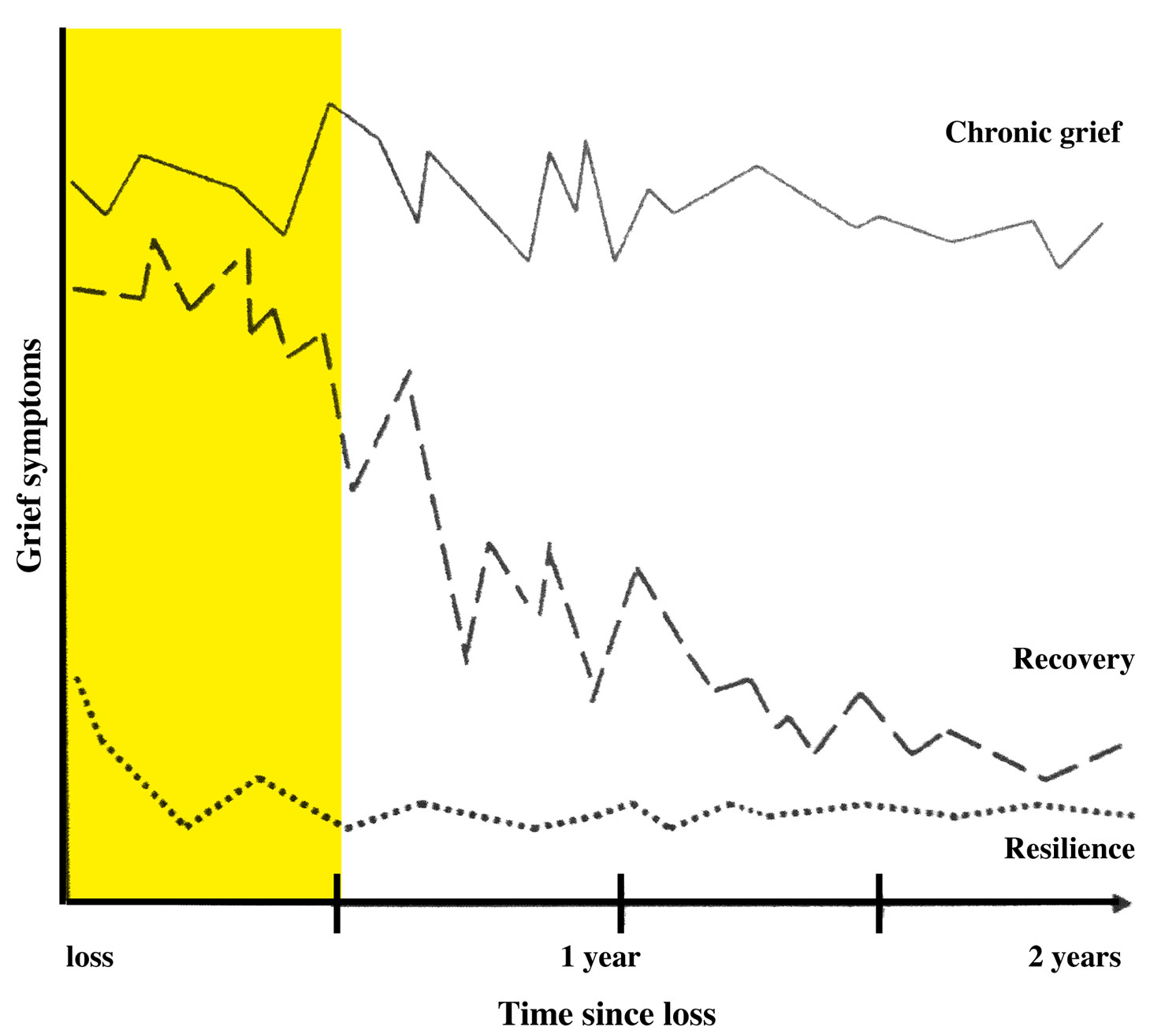
For me and my family, it means six months of the “after.” It’s the six-month milestone of “new normal.” In charts and graphs about grief and bereavement, it’s often the first milestone in the timeline, like this one from The Other Side of Sadness by George Bonanno (yellow highlighting is mine):

I first saw this chart, and the book that contains it, around the two-month mark. It meant so much to me to learn that science shows that bereaved people fall into one of three categories — chronic grief, recovery, and resilience. Until that point, I’d only found memoirs and books written by therapists that made it seem that most people were chronic grievers who only reached a sense of “recovery” after years of therapy and support groups (if ever).

Turns out, many of us — perhaps even most of us — fall into the “resilience” category. It’s hard for researchers to know for sure what the percentages are, because these aren’t the people writing memoirs or visiting therapists for years on end, and therefore aren’t on the radar of the therapists and grief counselors who are writing books about their work.

I wrote a lot about The Other Side of Sadness in my two-month blog post, and it seems fitting to revisit it again now. One of the most fascinating details about the scientific research described in this book is that they studied people both before and after their loss. Because of this, the researchers were able to discern the difference between someone who started displaying frequent and prolonged grief symptoms after their loss, vs. someone whose personality and outlook on life was grief-like even before the loss.

The researchers were able to identify personality traits of each group that were apparent before and after their loss. My friends and family would probably agree that the traits observed in “resilient” people sound a lot like me (and my husband, too). The research showed that resilient people are:

  • optimistic
  • flexible (can share AND suppress emotion)
  • can find benefits, and believe that “the world is basically a decent place, and life is good”
  • have a support system of family and friends
  • are “able to evoke comforting memories of the lost loved one”

With six months behind me now, I have a new appreciation for Mr. Bonanno‘s observation that “the human inquiry into the mysteries of life and the nature of the soul is acute during bereavement. When a loved one dies, we have no choice but to face up to nearly imponderable questions…. Many of us discover, in fact, that we have found something quite profound hidden in the experience.”

I’ve now had six months of “facing up to imponderable questions.” I wholeheartedly agree that “the mysteries of life and the nature of the soul is acute during bereavement.” I’ve pondered the imponderable. I’ve inquired into the mysteries of life. I have a new understanding of what it means to be human, and what it means to be alive. If there could possibly be a silver lining to this experience, that’s it.

I’ve survived six months of the after. I’ve spent six months creating new normal. I don’t know where I’ll be in 6, 12, and 18 months from now, but I know I’m resilient. And I know my future will be filled with happiness — because I choose to make it that way.

 
4 Comments

Posted by on September 3, 2011 in the second six months


Tags: , , , , , ,

It’s time for a new chapter in the American history of death.

For much of our American history, it was not uncommon for a family to lose a child. Disease, childbirth, war, and lack of hospitals made it unusual for a household *not* to have been touched by death in some way.

Despite the frequency of death, or perhaps because of it, grief was not discussed in those days. Grief was expressed in the appropriate times and places, such as at a funeral, but it was not discussed. Our American ancestors were never urged to go to group therapy to revisit their loss… over, and over, and over.

Then, there were two important changes in our country’s history. First, the medical world made significant advances: hospitals became more accessible and more sanitary, vaccines were discovered and distributed, and diseases became more curable — resulting in fewer deaths. Second, death became a topic of interest among philosophers and psychologists, who suggested that death had become an “unnatural taboo” which caused repression of emotion that would surely cause damage to one’s mental health.

On one end of the pendulum swing, in 1911, an article called “Facing Death” in Harpers Bazaar said, “Grief is self-pity. Perhaps if we were less centered upon our own happiness, grief over the loss of our beloved ones would not be the terrible thing that it is.” On the other end of the pendulum swing, the 1960s and 1970s brought about an emphasis on self-expression, talk therapy, and the overwhelming influence of Elisabeth Kübler-Ross‘s book On Death and Dying* published in 1969. By the late 1990s, it had become a widespread belief that people must “give voice” to their grief, or else it would fester. And now we do get urged to go to group therapy to revisit our loss… over, and over, and over.

In other words, death went from being a frequent occurrence with an expectation of limited outward expression, to being an infrequent occurrence with an expectation of significant outward expression.

Here’s why our culture’s history of death is of interest to me: I believe we must let the pendulum fall closer to the middle. I want us to all be thankful that the death of a child is so uncommon… but I want us to remember that it is not unheard of. I want us to respect those who choose to express their grief outwardly… but not judge or “worry about” those who don’t. I want us to remember that life is a gift… but also remember that death is part of the same cycle. I want us to honor the loved ones we have lost… but not lose ourselves in the process.

It’s time for a new chapter in our American history of death. In this chapter, we don’t expect people to die, and we don’t expect people not to die. We don’t judge people for expressing themselves, and we don’t judge people for not expressing themselves. We mourn the ones we have lost, and we celebrate that we had them in the first place. We remember the loved ones who have died, but we never forget that we are still alive… and we have a lot of living left to do.

* Note: I wrote about this book in one of my first blog posts, and I’ll be writing about it again in one of my next blog posts.
 
7 Comments

Posted by on August 31, 2011 in month 6


Tags: , , , , , , , , , ,

Red sunsets.

I feel like it’s been a long time since I wrote a blog post. Early on, I wrote because it was therapeutic and the writing process created a good structure for me to understand my own thoughts and feelings. Later, I wrote because I was reading books and discovering new things that I wanted to explore. Today, I’m writing just to share what’s going on in my life.

When I wrote my last blog post, I was at a cabin on a beautiful MN lake with my extended family. It was hard to be there without Julian, but it was a wonderful week. The relaxing environment and the beauty of the lake made me feel more peaceful than I’ve been since Julian died.

Almost immediately after leaving the cabin at the end of the week, I longed for more. I instantly missed that peacefulness the lake inspired in me, and I had a whole new appreciation for getting away and having focused family time. John and I talked about it, and we decided to consider buying our own cabin. We started researching our options.

I have now viewed hundreds of cabins online. Both Minnesota and Wisconsin have beautiful lakes within driving distance of our home. We want something small, and certain details are important to us — for me, feature that is most important is that the cabin must be West-facing. I need to be able to see the sunset.

My whole life, I’ve sought out the sunset. I’ve planned vacations specifically to see the sunset over the ocean. I’ve strategized the best reservation time to watch a sunset from a restaurant. My boys would sometime’s tease me about needing to “watch mommy’s sunset.” If we are going to buy a cabin, a beautiful sunset is a must.

Two weeks ago, we rented a cabin that is also for sale. It had wonderful ’70s modern architecture that reminded John and I of our own house… but most importantly, it had what the owners describe as an “Aloha sunset.” We were only there for 2 nights, and I was so disappointed when the first night was cloudy. I could see a glow in the distance where the sunset would have been, but not the real deal.

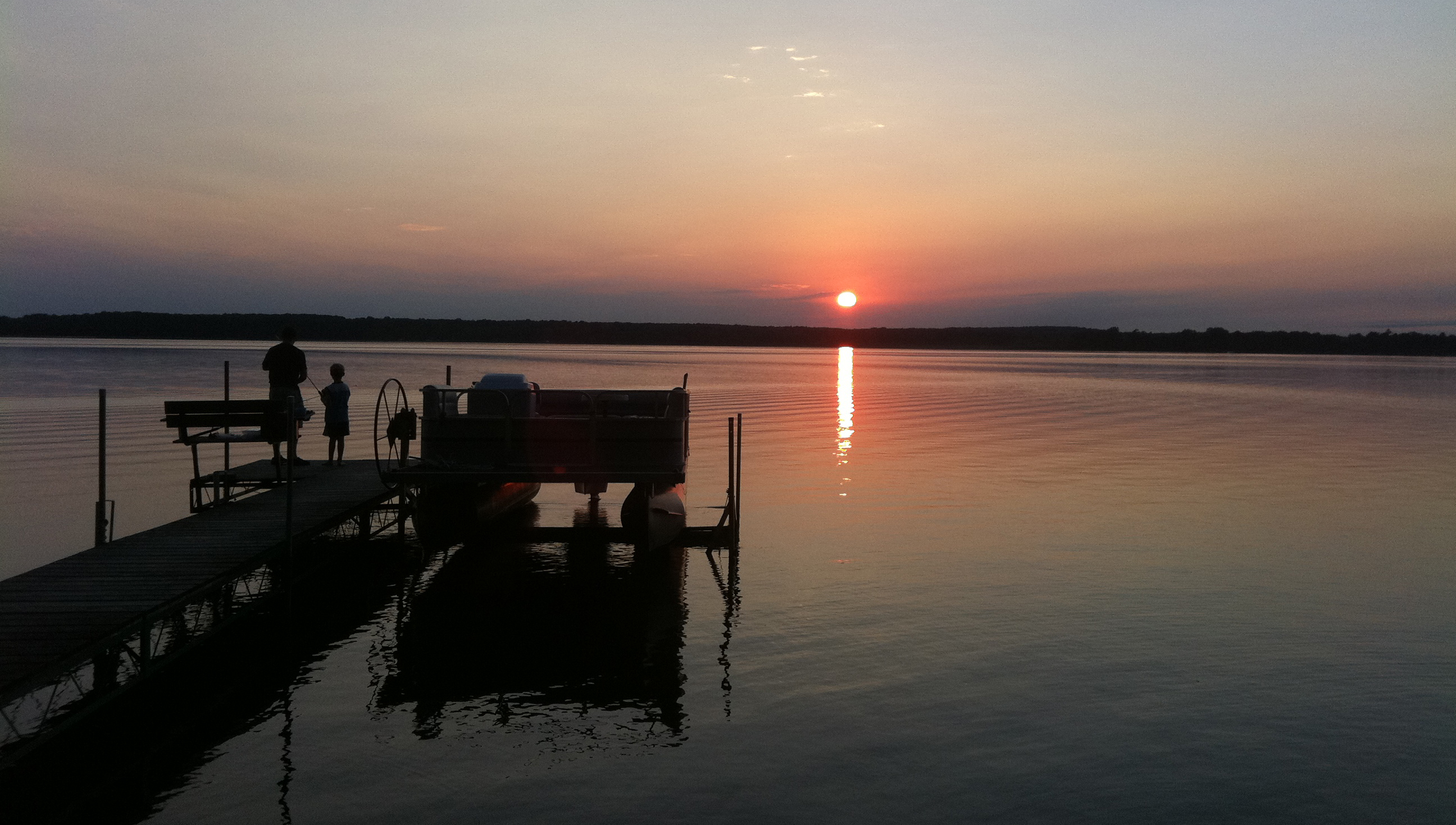
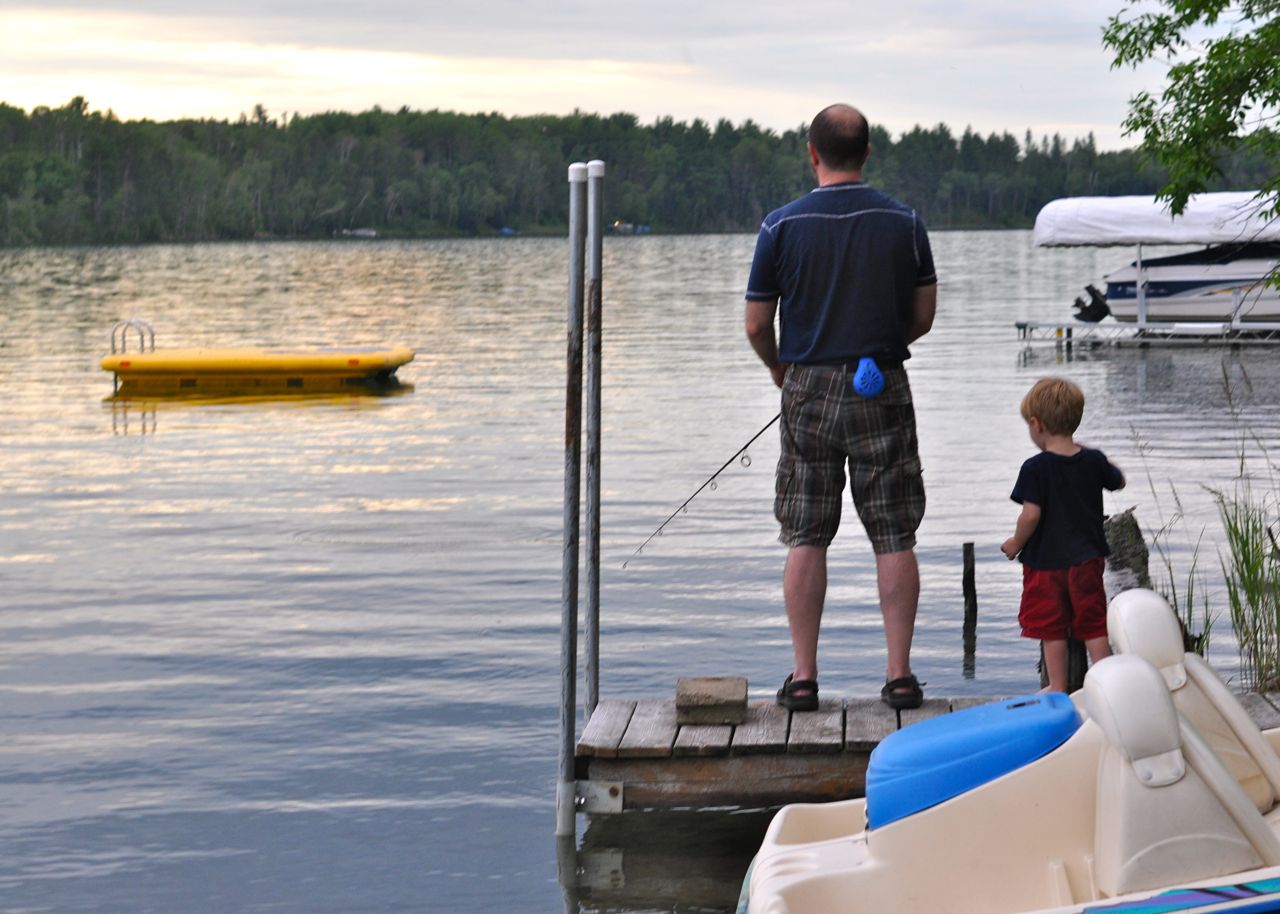
The second night was beautiful. It was, indeed, an “Aloha sunset.” As I sat there on the shoreline, I watched John and Oscar fishing right off the dock (and actually catching fish!). It reminded me of the times when Julian was John’s fishing buddy, as shown in this cute photo, and this one too.

I was entranced as I watched the sky change from blue to purple to orange and red. When the red tones came out, it hit me. THIS is why sunsets are important to me. The red sky, the beauty of nature, the cycle of sunrise to sunset, the cycle of birth to death. THIS is where I feel close to Julian’s spirit. His favorite color, red, is what makes a sunset beautiful.

From now on, every time I see a sunset, I will think of my sweet boy and the beautiful things he contributed to my life. Hopefully, soon, we will own a cabin with a sunset of our own. Until then, all I have to do is look at the photos I took (like the one shown above), and I feel peace.

___________________________________________________________

UPDATE ON 8/10/11: This week we made an offer on the cabin I mentioned in this post, and it was accepted! Now we will own that sunset — and the sweet little cabin that looks out over the lake. We look forward to creating wonderful family memories there.

 
7 Comments

Posted by on August 8, 2011 in month 5


Tags: , , , , , ,

Unfortunate or privileged, bad stuff happens to everyone.

Julian with his cousin Micah and his brother Oscar, one year ago today (Fourth of July, 2010)

Yesterday was the 4-month anniversary of Julian’s death. I tried to write a blog post, but I couldn’t decide what to write about. Should I write about this specific 4-month milestone? Should I write about the lake cabin we are at right now, and how much Julian loved being here exactly one year ago? Should I write about how this is Fourth of July weekend, and every holiday is one more holiday without him? Should I write about one of the myriad insights and surprises I’ve discovered in these four months? Or about the many books I’ve read about grief and bereavement? Or how I’ve changed as a person and a mother?

I couldn’t decide. So I didn’t write much of anything. But this morning when I woke up, there was just one singular Deep Thought on my mind: Bad stuff happens to everyone, regardless of what we want or expect. As human beings, we shouldn’t expect to have a perfect life — but we do. We expect businesses to not have layoffs. We expect houses not to get foreclosed on. We expect to have the health care we need, with doctors that cure all disease and hospitals that always save the lives of our loved ones.

Sometimes (hopefully, usually) our expectations are met. We stay employed, we keep a roof over our heads, our families stay healthy. And in my case, it’s so much more than that: Not only am I employed, I own a business with my husband and I get to do work that I love with people who I love for clients that I love. Not only do I have a roof over my head, I have a lovely home on a beautiful wooded lot in a location that is ideal for my family. And up until 4 months ago, I would have been able to tell you that not only do I have the health care I need, I have never needed doctors to cure diseases and save the life of loved ones.

And then that changed. Life wasn’t perfect anymore. Life was very, very imperfect.

My perfect little boy — 25% of my perfect family, living under our perfect roof, being supported by our perfect business, and being treated by perfect health care — left the planet. No one knows why he got leukemia in the first place, and no one knows why he developed an infection that wasn’t even slowed down by the very best doctors using the very best medicine at the very best pediatric hospital in the midwest.

It just happened.

It’s so easy to go to that place of, “Why me?” Why my family? But then I take a moment and think, why not me? As certain as I am that none of us did anything to “deserve” this loss, I also have to recognize that the opposite is true: none of us did anything NOT to deserve this loss. This is life. There’s no shortage of clichés about it… what makes us stronger, glass half full, lemons from lemonade, blah blah blah. But sometimes we just need to remind ourselves of the succinct and well-put classic:

Sh*t happens.

That’s what it comes down to. Sh*t happens. Bad stuff happens. All the time. To everyone. If you are human, you can’t escape it. If you are human, you WILL feel pain — physical, emotional, life-changing, heart-wrenching pain. And ultimately, pain is pain. My pain may be different from your pain, but your pain is just as real as mine.

Today, four months after the death of my young son, I don’t ask, “Why me?” I don’t compare myself to “more fortunate” families who haven’t experienced the tragedy of a child’s death. It’s no coincidence that a book I was reading yesterday included this quote from Helen Keller:

Instead of comparing our lot with that of those who are more fortunate than we are, we should compare it with the lot of the great majority of our fellow men. It then appears that we are among the privileged.

Helen Keller, We Bereaved, 1929

I have one great big reason to feel less fortunate than others, but I have a whole bunch of reasons to feel privileged. The death of my child doesn’t make me a victim of fate any more than Helen Keller was a victim of fate. Sometimes, people are born without the ability to see or hear. Sometimes, children die. Also: soldiers go to war and don’t come back, people text at the wheel, companies lay people off, homes get foreclosed on, earthquakes and tsunamis destroy whole communities, cancer invades bodies, modern medicine cures less than 100% of patients. Bad stuff happens.

These four months have taught me a lot. Some of it, I wish I didn’t have to learn. Some of it, I appreciate. Today I’m appreciating my new understanding that my pain is not unique. Sooner or later, in big or small ways, we all feel pain. “Why me?” isn’t the question to ask. The question to ask is, who do we choose to compare ourselves to? What do we choose to feel — unfortunate, or privileged?

Today — as I celebrate the Fourth of July at this beautiful Minnesota lake cabin, as I watch Oscar and my nephews playing in the lake that Julian loved so much last year, as I enjoy time with my parents and siblings, as I feel healthy and secure — I feel privileged. I miss my son, I would do anything to have him here with us, and I feel privileged.

 
9 Comments

Posted by on July 4, 2011 in month 5